“Not what we have but what we enjoy constitutes our abundance.” ~ Jean Antoine Petit-Senn

Photo Credit: Kevin Jordan, Manhattan Beach, CA, 2026
Greetings -
I hope you, your families and friends are well as we slide off of the pre-holiday season precipice. For those hitting the road or taking to the skies over the upcoming Gobble Gobble holiday, have fun, be safe and stay warm. We are looking forward to fun family time with our daughter, who will be visiting us in California over the long weekend!
The holiday season and impending calendar year end offer important reminders re: the power of gratitude and generosity at work and at home (though this time of year should hold no monopoly on the thoughtful and creative expression of both.) Pragmatic suggestions to praise and appreciate folks in ways that personalize their specific contributions and honor their efforts abound.
In the spirit of appreciation, I would like to thank this gracious community for your kindness and generosity of spirit. With gratitude, respect and deep admiration, I wish you a happy start to what I hope is a joyous season with family and friends.
Happy reading and listening!
-kj
PS - (Missed a newsletter? Past editions can be found here: https://www.kevinjordan.coach/blog. And if you hit paywall on an article(s), feel free to send me a note and let me know what you need. I have subscriptions to many of the sources that I cite.
Featured: How to Build a Superteam That Keeps Getting Better
The best teams see change as both a challenge and an opportunity — one that calls for individual greatness in service of collective excellence. And the teams that become an integrated, high-functioning whole share a common starting point: trust.
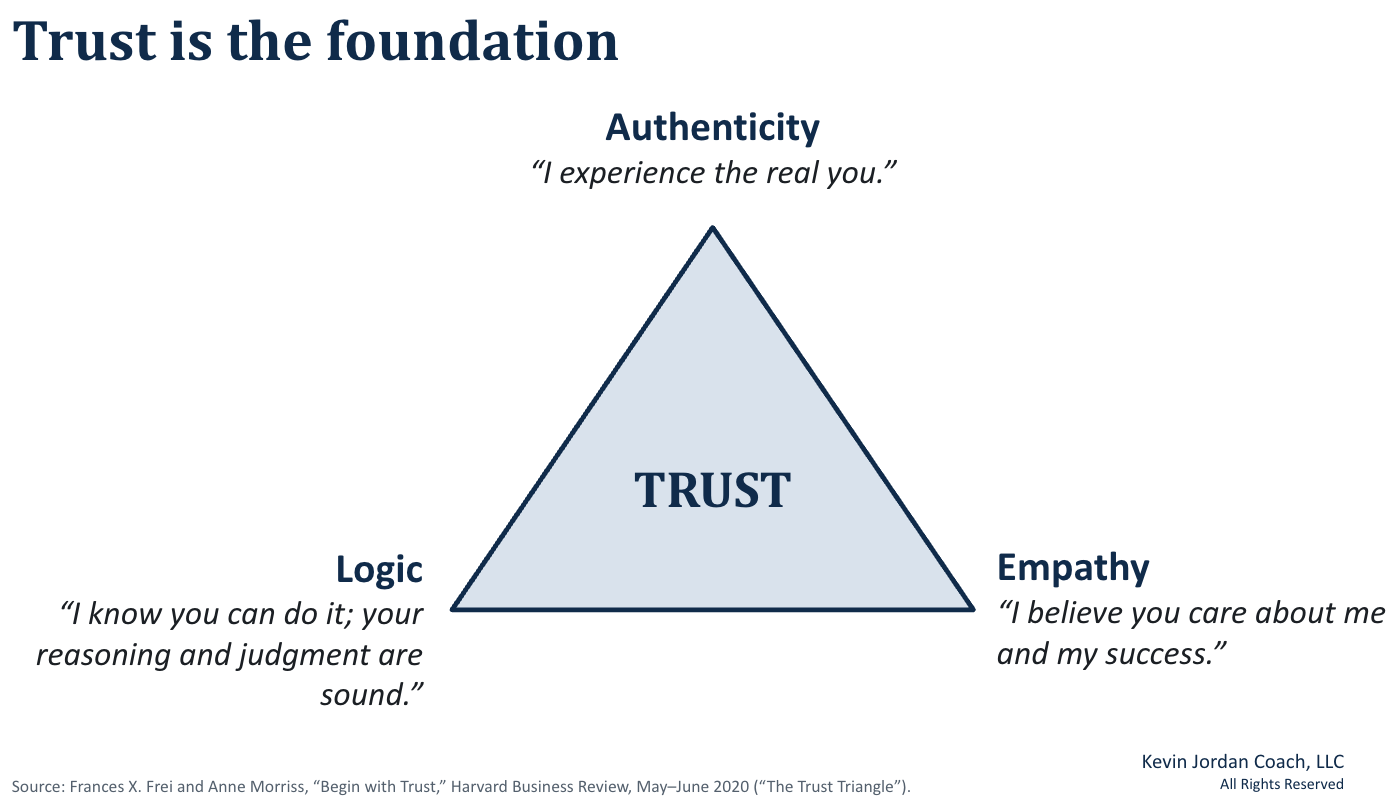
Trust rests on three drivers: 1) Authenticity; 2) Logic; and 3) Empathy. With these drivers in place, trust flourishes. More to the point, it enables psychological safety which in turn enables growth, productivity, increased capacity, strategic risk taking and learning. Complementing this research, Ron Friedman points to Google's landmark study of 180 teams, which found psychological safety to be the single strongest predictor of team performance.
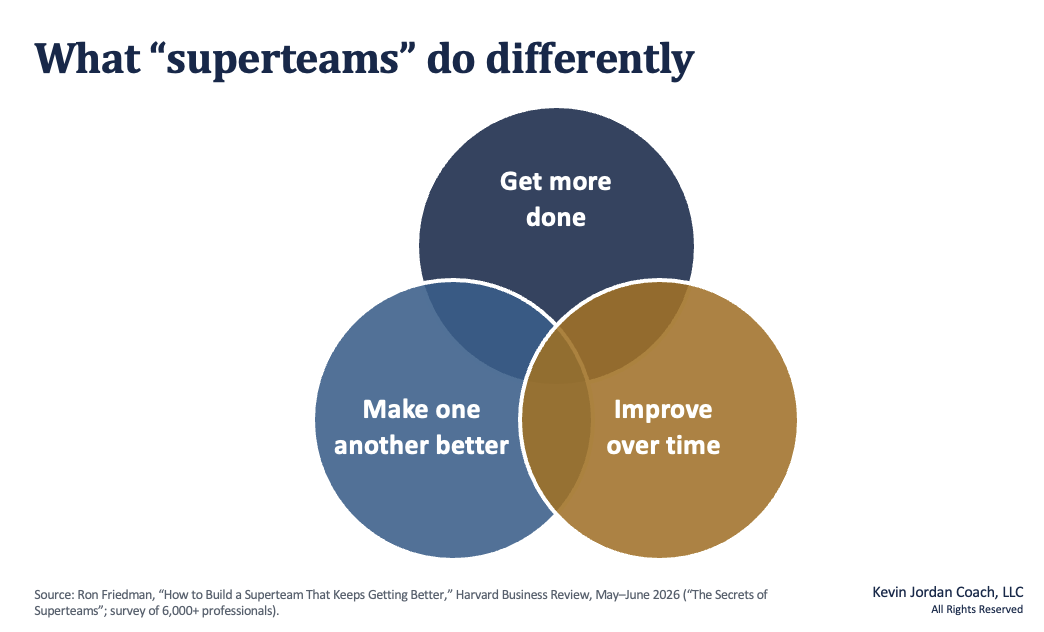
When trust and psychologically safe behaviors are role-modeled and reinforced, teams can transform into, what Friedman and his colleagues refer to as, "superteams." What defines these "superteams?" Three key areas of strength set them apart: 1) increased productivity gains, largely because they manage time, energy and attention exceptionally well; 2) they all get better - individual success fuels, and is in service to, collective success; and 3) they keep raising their bar over time by expanding their mindsets, knowledge base and skillsets. So, how do the best leaders build these strengths and realize the gains?
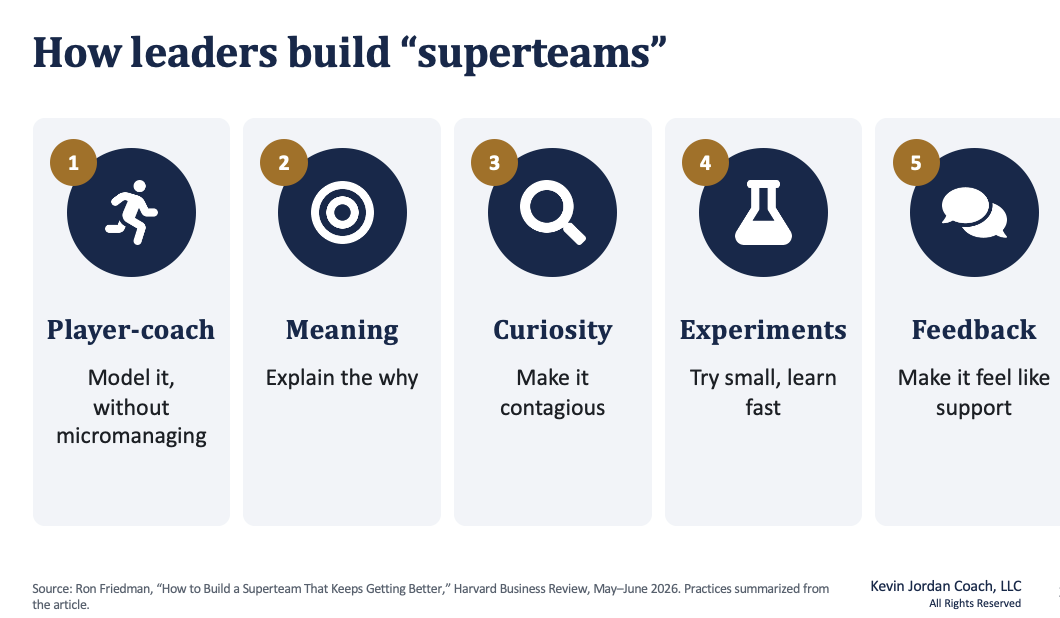
Friedman offers the following research-backed practices:
1) Be a role model and roll up your sleeves. 78% of superteam members say their manager is actively involved in the work, compared with 55% on average teams. The distinction is involvement versus micromanagement; leaders build their team's capacity rather than taking the work over.
2) Provide the context and the why, not just metrics. Superteam leaders were 59% more effective than average-team leaders at helping their teams understand why what they were doing was important.
3) Faciliate inquiry. Compared to leaders of average teams, they're 56% more likely to ask thoughtful questions and 53% more likely to show genuine interest in learning from their employees.
4) Test. And test again. 62% of superteams run small experiments to improve how they work, compared with 42% of average teams. Most importantly, their leaders are three times more likely to reward intelligent risks!
5) Frame feedback to encourage and grow. On superteams, more than 90% of workers say their leader delivers feedback that motivates improvement without sounding critical.
Taken together, leaders have the opportunity to accelerate team growth and deliver out-sized results leveraging the very best of what individually and collectively their teams have to offer.
Articles
Harvard Business Review: Most Employees Don’t Trust Their Leaders. Here’s What to Do About It. "Leaders play an instrumental role in building organizational trust—a role that’s increasingly challenging and important amid today’s constant disruption. Organizations that empower leaders to articulate decision rationales, demonstrate accountability, and refine their leadership practices while assessing and addressing trust deficits on a consistent basis will ultimately foster a more engaged and cohesive workforce that’s better equipped to navigate the complexities of today’s volatile environment."
Harvard Business Review: What Operating Rooms Can Teach Leaders About Team Design. "...Our research and field experience suggest that team structure, not technology, is the most powerful lever for improving OR performance. By redesigning how people collaborate, hospitals can achieve meaningful improvements quickly and at minimal cost. Technology can and should support progress. But thoughtful team design is what drives it." [KJ note - there are many applicable principles and practices in this piece that extend beyond hospitals and operating rooms.]
Harvard Business Review: How to Successfully Drive Change When Everything Is Uncertain. "While traditional change management emphasizes gradual tactics like pursuing small wins and building coalitions, in turbulent times these gradual tactics aren’t necessary—and they can hold leaders back from taking advantage of bigger opportunities. Research from healthcare settings during Covid show that both senior leaders and frontline managers are more successful at prompting change during turbulent times when they do three things: 1. Selecting a shovel-ready idea and reframing it as a solution to a problem at hand as well as long-term success, 2. Moving quickly to take advantage of a window in time when people are more open to change, and 3. Thinking more expansively about what’s possible."
The Wall Street Journal: 20-Somethings Are Ditching Entry-Level Jobs to Become Their Own Bosses. "AI is shaking up the employment market for younger workers—and making it easier for them to become entrepreneurs."
A.I. Perspectives
KJ note: I am not immune to the tsunami of A.I.-related publications daily infiltrating my feed. While many are of marginal value, I have curated three thoughtful articles (all hyperlinked below) over the last few months and shared them with clients and colleagues. I hope they serve you well too. [And no, A.I. is not becoming a substantive focus of this newsletter :)]
"Generative AI and content platforms make it effortless to sound authoritative, [leaving] organizations overwhelmed by polished insight that rarely translates into real change. The growing gap between those who talk about the future of work and those who actually build it has turned expertise into performance, leaving leaders stuck. What creates progress instead is a different discipline: hands‑on experimentation by operators willing to test ideas in messily real conditions, learn from failure, and share unvarnished results...[To add to this], AI is changing not only what leaders need to know, but how they need to think...To keep pace, [leaders] need to shift the mindsets that shape your behavior in three important ways: from certainty to clarity, from expertise to exploration, and from emotional control to emotional insight. Finally, knowledge does not scale unless employees are willing to make it visible—and that willingness depends on whether they believe the organization will handle what they share fairly...Leaders often focus on whether their people are using AI. The harder question—and the one that determines whether the productivity gains AI promises will actually accrue to the organization—is whether employees trust the organization enough to share what they’re learning."
Blog Posts & Opinions
Johnny C. Taylor, Jr. (LinkedIn): The Leadership Layer You've Been Ignoring Is Starting to Crack. "We spend enormous energy designing employee experience programs for our frontline teams. We invest in executive coaching, C-suite retreats, and leadership development for the top floor. But the people in the middle? We assume they'll figure it out. And quietly … they're cracking."
Jessica Kriegel (LinkedIn): Loud Working Is a Leadership Problem. "A recent Business Insider article describes a growing workplace trend where employees are going out of their way to make sure executives notice their contributions. They're taking on high-visibility projects, talking more about their accomplishments, and making sure everyone knows how valuable they are. And for many, the motivation is fear of losing their jobs."
Chris Marquis (The New York Times): I Teach at a Business School. It’s Time to Shut Them Down. "Still, the experience has reminded me why abolishing business schools cannot mean abandoning the people in them. The goal is not to write off the students as aspiring selfish capitalists; it is to stop funneling them through a machine that narrows their sense of possibility. Many of my students arrive on campus wanting to work on the crises that our economic system has created. What they lack is an institution that is worthy of their better impulses."
Podcasts
HBR On Leadership: Why Speed and Trust Are Critical to Solving Hard Problems. "When it comes to solving complex, layered problems, the default for many organizational leaders is to take their time to work through the issues at hand. Unfortunately, that often leads to problems that linger with no clear resolution. Instead, Anne Morriss offers a different problem-solving framework based on speed, momentum, and trust."
HBR IdeaCast: The Leadership Skills That Make Transformation Stick. "Why do so many organizational change efforts stall or flat out fail? Julia Dhar, managing director and partner at Boston Consulting Group, says the problem often isn’t strategy, it’s behavior. Leaders spend enormous time designing change, but far less understanding whether employees are willing, motivated, and equipped to adopt it. She shares research around how leaders can create genuine alignment, and what it takes to sustain momentum once the novelty fades."
Coaching Revealed: The Leader-as-Coach Approach with Ruth Reitmeier. "...Ruth draws from her research and work with MBA students while exploring the impact of the leader-as-coach training intervention on leadership identity, developmental self-concept, and aspirational clarity...Key topics covered include: 1) shifting towards a coaching mindset in leadership problem-solving; 2) utilizing coach training to produce measurable and scalable leadership growth; and 3) exploring areas of benefit for coaching based-leadership including trust building and team efficacy."
Arts, Music, Culture & Humor Corner
National Geographic Magazine: Origami is revolutionizing technology, from medicine to space. "The centuries-old art of folding paper is yielding new applications in spacecraft, architecture, and even the human body."
The New York Times: The Interview: 50 Years In, What’s the Point of U2? Bono and the Edge Have Answers. "...I spoke with Bono and the Edge, the band’s two principal songwriters, about their long working relationship, friendship, and what U2 still means — both to them and to the world."
Scott Galloway: No Mercy / No Malice (LinkedIn): Preparing men for others. "One day soon I’ll be gone. The houses will belong to someone else. The businesses will have new names. It’s all happening and disappearing so fast. My fear of death, however, is waning, as while I’ve spent my life trying to build things that would outlast me, I now recognize I’m raising them [his sons]. And that’s comforting."
Esquire: Inside the Secretive, Anxiety-Ridden Making of the Seinfeld Finale. "The year of our Lord 1998 should have been a banner year for Larry David. Then he had to go and write the send-off for the most acclaimed television comedy of all time."
Reflections
“There are two ways of spreading light: to be the candle or the mirror that reflects it.” ~ Edith Wharton
"And so it is that most people have no idea how beautiful the world is and how much magnificence is revealed in the tiniest things, in some flower, in a stone, in tree bark, or in a birch leaf. The grown-ups, going about their business and worries, and tormenting themselves with all kinds of details, gradually lose the perspective for these riches that children, when they are attentive and good, soon notice and love with their whole heart. And yet the greatest beauty would be achieved if everyone remained in this regard always like attentive and good children, simple and pious in sensitivities, and if people did not lose the capacity for taking pleasure as intensely in a birch leaf or a peacock’s feather or the wing of a hooded crow as in a mighty mountain or a splendid palace. What is small is not small in itself, just as that which is great is not great. A great and eternal beauty passes through the whole world, and it is distributed fairly over that which is small and that which is large; for in such important and essential matters, no injustice is to be found on earth.” ~ Rainer Maria Rilke