Blog title: "To live our lives with an Infinite Mindset is to live a life of service." ~ Simon Sinek
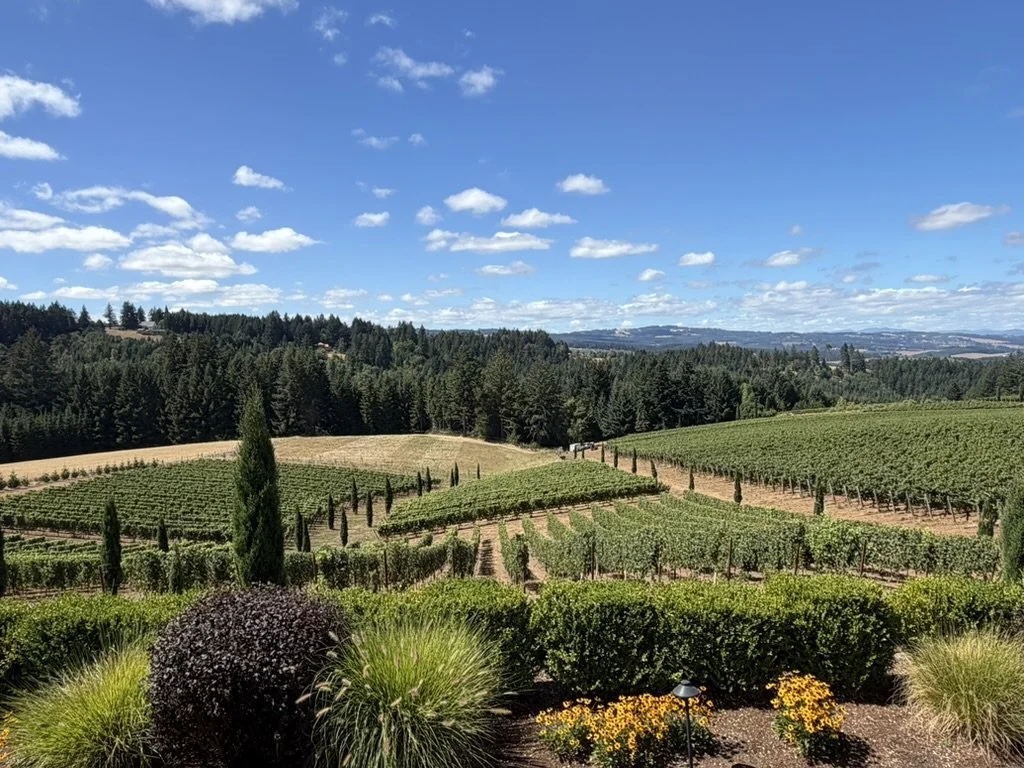
Photo Credit: Kevin Jordan, Alloro Vineyard, Sherwood, OR, August 2026
Greetings -
I hope you, your families and friends are well and easing into the early days of Fall.
September has been a wonderful whirlwind of activity and travel. The month kicked off with a lovely Labor Day weekend visit from our daughter. We enjoyed an eclectic weekend of exploring, wine tasting, various dining adventures and generally laughing our way through the warm and waning days of summer. My wife and I had a ball (and we hope our daughter did too!). We are grateful for the chance to spend time and connect with her (and, as always, it was way too short.)
The second half of the month has been marked by travel, with my first journey to Manhattan Beach, where I was lucky enough to combine seeing clients and dear friends in a great work-play week. It is always a treat to make this trip and enjoy the lovely confines of southern CA. My second journey took me and my best friend from college on a road trip from Manhattan Beach back to the family home in Inverness. We are working, playing and planning to host several other college friends later this weekend. Such great fun!
A couple of editions back I wrote about how each year I look for new opportunities to pay forward the many great gifts I have received over the course of my career. My opportunity this year took the form of a volunteer career coach and mentor working virtually with a small cohort of talented, undergraduate Braven Fellows from Spelman College in Atlanta. We are almost at the half-way point in the semester-long program and I am thoroughly enjoying the students and the overall experience. Their energy and excitement is refreshing and their educational and career aspirations are ambitious. I am thrilled to be a small part of their experience as they chart their respective paths forward. (For those not familiar with Braven, it is a national non-profit, with a mission "to equip promising college students with the skills, networks, confidence, and experience necessary to transition from college to strong economic opportunities, which lead to meaningful careers and lives of impact.")
This edition, in part, looks at what it takes (and the benefits of) successfully translating individual talent into collective success. There is an array of reading and listening perspectives, ranging from optimal team structure to necessary skillsets to thoughtful physical space configurations for individuals and teams to thrive. The Blog Posts / Opinions section offers thoughts on the myth of solo success and the power of asking for support, the state (end-state?) of modern management in the wake of A.I. and whether we really are more sensitive at work or if other factors might be at play.
With respect and deep admiration for you all, happy reading and listening!
Be well, take good care of yourselves, families and community.
-kj
PS - (Missed a newsletter? Past editions can be found here: https://www.kevinjordan.coach/blog. And if you hit paywall on an article(s), feel free to send me a note and let me know what you need. I have subscriptions to many of the sources that I cite.)
Featured: How to Turn Individual Talent into Organizational Excellence
Josh Bersin's book, Irresistible: The Seven Secrets of the World's Most Enduring, Employee-Focused Organizations, offers a compelling vision, one rich in data and insights, for what makes organizations truly great. As important, he delineates how they sustain excellence over time. His framework describes the journey from hierarchy to teams, jobs to work, boss to coach, rules to culture, promotion to growth, profits to purpose, output to employee experience. It's both a clarion call and a practical north star for how to lead in the 21st century.
James Fulton and Todd Warner's work both echoes and builds on the idea that sustained organizational excellence isn't about talent alone, or culture initiatives or better incentives. Success depends on intentional and thoughtful design. The organizations that excel do so by ensuring that talent development is embedded in the work itself, teams enforce cultural standards and the routinized operations of the organization make excellence unavoidable.
Together, their collective frameworks point toward the same truth: the organizations where people truly flourish do not happen by accident. They are designed with care, intentionality and a deep commitment to what is best for the collective while attending to the needs of each individual.
Today's workforce runs on agility, agency and equity. Leaders have both the opportunity and the responsibility to create environments where people are seen not just for who they are, but for who they might become.
Articles
Harvard Business Review: How to Build a Superteam That Keeps Getting Better. "[Success] grows out of the disciplined pursuit of continuous improvement. It originates in leaders who stay curious, ask hard questions, and roll up their sleeves when it matters most. It results from teams that experiment boldly, treat feedback as fuel, and find meaning in the work they share. Those are the habits that turn good teams into superteams. Any team can cultivate them, whether in basketball, business, or beyond."
Harvard Business Review: The Office Amenity That Actually Improves Teamwork. "Teams need opportunities to discuss ideas, coordinate their efforts, and make decisions. But they need individual members to think critically, solve problems, and execute those decisions. That work requires uninterrupted concentration, and a quiet workspace makes it possible."
KelloggInsight: 5 Traits That Set the Best Leaders Apart. "A former CEO and current executive coach discusses the tendencies of these high performers, including sharing credit and ignoring shiny objects."
Gallup: Span of Control: What's the Optimal Team Size for Managers? "Leaders face pressure to make decisions about how to best manage their workforce’s size and structure. Uncertainty about the future effects of AI on team size and employee management may add extra pressure to define the “ideal” span of control in management. Gallup research suggests that the answer depends on four factors: 1) How engaged is the team? 2) How much time do managers spend on individual contributor work? 3) Do managers have the right talent for the role? 4)Do managers give employees meaningful, regular feedback?"
The Wall Street Journal: Helicopter Parents Are Co-Piloting Their Adult Children’s Careers. "Mom and dad are calling up hiring managers, applying for jobs on their kid’s behalf, and even lurking just off-screen on Zoom calls."
Research
University of Waterloo: People disregard advice when making tough decisions. "Insights from investigation of decision-making among people in 12 countries could improve teamwork and cross-cultural relations."
Harvard Business School's Working Knowledge: Want People to Commit? Make Signing Up a Little Harder. "Despite their best intentions, people often struggle to stick with products or programs. However, making them slightly harder to access boosts appeal and follow-through."
Blog Posts & Opinions
The New York Times (Angela Duckworth): I Study Successful People. They Have One Habit in Common. "You might think I’d love the image of the solo striver triumphing over every challenge. After all, I’m a psychologist who wrote a book called “Grit” about the necessity of passion and perseverance for achieving long-term goals. The truth is, I hate it. Without exception, every high performer I’ve studied credits a host of supporters for success. Research has found that a willingness to ask for help is crucial to achievement."
Substack: (Sam Jacobs): Central Intelligence: The end of management as we know it. "If AI systems can coordinate work and if they can house the collective heartbeat of the entire living breathing organization. If there is a layer of basic analysis, judgement, and execution running all the time, 24 hours a day, 7 days a week. A machine that can track progress, route tasks, synthesize decisions, surface noise that’s just become signal. Well if that starts to happen, the historical reason for management begins to disappear entirely. And if that disappears so too does the entire apparatus to support it."
LinkedIn: (Catherine Mattice): Why Are People So Sensitive? 4 Things Have Changed at Work. "Some employees need stronger resilience. Some need to get better at receiving feedback. Some need to recognize that disagreement, accountability, direct communication, and occasional interpersonal friction are normal parts of working with other humans. But that's only half the conversation.
Leaders also need enough self-awareness to recognize when “too sensitive” has become their favorite defense against feedback. Organizations need enough courage to examine patterns rather than protect a high performer because confronting them would be inconvenient. And HR needs enough nuance to distinguish between an employee experiencing normal workplace discomfort and an employee describing a genuine pattern of damaging behavior.
So, before you decide your employees are “too sensitive” or spend money fixing the wrong problem, find out what’s actually happening."
Podcasts
HBR On Leadership: How Leaders Create the Conditions for Innovative Thinking. "Today’s leaders need to be able to innovate over and over again despite fast-changing market conditions and a multitude of other uncertainties. Harvard Business School professor Linda Hill...explains why leading innovation requires a different set of leadership skills including the need to shift from a focus on decision-making and producing to creating the conditions for collaboration, experimentation, and smart decision-making across teams, silos, and wider ecosystems."
The Curiosity Shop with Brené Brown and Adam Grant: Courageous Leadership as a Daily Practice. "...They explore why courage now has to mean being a learner instead of a knower, and why values aren't just what you care about-- they're what you sacrifice for. The conversation moves through the four skill sets of courage, why a value that isn't operationalized into behavior is just a poster with an eagle on it, and how to use the "story I'm making up" framework for hard conversations."
Work Life with Molly Graham: Why you should take a risk every day with Julie Zhuo. "When you think about risk, you probably think about big, dramatic moves: quitting your job, moving across the country, saying something controversial. But the people who are actually good at taking risks are the ones who practice small challenges every day...In this episode, Molly and Julie dissect what it actually means to take a risk and how you can build your risk-taking skills through daily practice."
Arts, Music, Culture & Humor Corner
The New York Times: He’s the Last Great Land Artist You’ve Never Heard Of. "Charles Ross spent 50 years building “Star Axis,” a naked-eye observatory in New Mexico. Now his masterwork is ready. How to share it with a changed world?"
Flood Magazine: Resurrecting Lost Sounds with Jim James. "The My Morning Jacket frontman chats about his meditative new psych-rock solo album Wowed Out and music’s capacity to heal."
The New York Times (Samuel Moyn): Older Americans Are Hoarding America’s Potential. "It is not ageist to ask whether older people should be required to give more to younger Americans and national priorities — it is critical to the future of our democracy and society. America needs to confront gerontocracy before the system collapses under the weight of its inequality and injustice."
The New Yorker: Welcome To Career Day. "Hi, class! Charlotte’s mom is here to tell you all about her very important career, which mostly consists of communicating with the A.I. chatbot that will eventually take over her job. Please be respectful and hold all unintentionally devastating comments until the end."
Reflection
The following is by Chip Conley (hat tip to KR for sharing this with me)
"Apparently, life comes with fine print.
No one gave it to me at birth.
Probably because I couldn’t read.
And now that I can,
the font is too damn small.
But I’ve picked up a few clauses:
No one is as obsessed with you as you are.
Naps will make you snappy.
Your body has an expiration date, but management refuses to disclose it.
Most things you worry about will never happen.
You will eventually become your parents in precisely the ways you swore you wouldn’t.
Objects in the rearview mirror may appear more meaningful than they actually were.
Past performance is no guarantee of future happiness.
And this one seems particularly important:
Terms and conditions are subject to change without notice.
So should we study the fine print?
Highlight it?
Memorize it?
Build our lives around avoiding every known side effect?
Maybe not.
Because the fine print is where the warnings live,
but the large print is where life happens.
Fall in love.
Make the call.
Take the trip.
Start over.
Forgive sooner.
Dance badly.
Order dessert.
Laugh with Dad as he farts…again, when he stands up.
Yes, read enough of the fine print to know that heartbreak, wrinkles, loss, uncertainty, and death are all included in the purchase price.
Then put down the contract.
Because perhaps the greatest danger isn’t failing to heed life’s warnings.
It’s spending so much time reading the fine print that you forget to live the headline."